Designing paths, experiences, and intelligent spatial connections in urban and public environments
At Mammute, smart wayfinding services are designed to enhance user experience in urban, commercial, and tourism spaces. This service combines expertise in urban design, UX, environmental graphics, and industrial signage design to create smooth, aesthetic, and user-centered navigation systems.
Smart Wayfinding Design and Implementation Approach at Mammute
Integration of Urban Design, UX, and Environmental Graphics
Smart wayfinding at Mammute is based on spatial analysis, user behavior understanding, and the design of movement experience. It is delivered through a multidisciplinary team of urban designers, UX specialists, environmental graphic designers, industrial signage designers, and copywriters to build a unified, legible, and user-centered system.
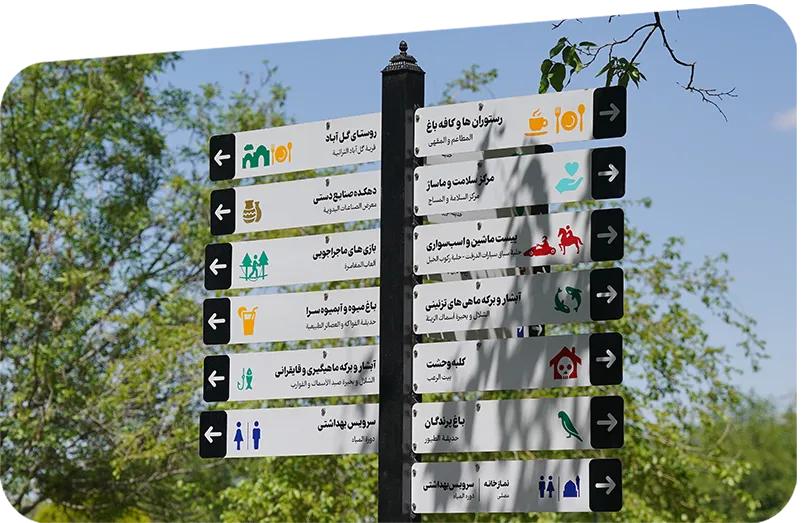
The process includes analyzing routes, decision points, user information needs, precise placement of signage, designing the visual identity of the wayfinding system, and producing both physical and digital signage elements. This service is implemented across a wide range of environments: parks and tourism complexes, sports facilities, shopping centers, urban districts, office and service spaces, cultural centers, hospitals, and institutional complexes. The ultimate goal is to create efficient navigation and a smooth, aesthetic spatial experience that enhances user satisfaction.
Smart Wayfinding Activity Categories
Spatial and user behavior analysis
Route and decision-point design
Signage, symbols, and environmental graphics design
Implementation, installation, and evaluation of wayfinding systems
Wayfinding projects are important because they integrate intelligent navigation with branding, elevating user experience in urban environments and large-scale complexes to a level where:
– Navigation becomes simple and easy to understand.
– It increases users’ sense of belonging and trust in the place’s brand.
– It improves user satisfaction and safety.
– It ensures visual consistency between branding elements and the physical environment.
Key Deliverables:
– A comprehensive signage database aligned with the brand and usable across different environments.
– Technical installation and maintenance manual with related branding guidelines.
– 3D models for precise visualization of signage placement and environmental coordination.
– A sustainable and smart system for continuous updates and brand identity maintenance.
Methodology
The smart wayfinding process begins with a detailed analysis of spatial structure and user behavior in urban environments or large-scale complexes. Signage systems are then designed based on international standards and aligned with brand identity elements. Signs are strategically placed at key points to maximize efficiency and visual impact. Next, a guideline document is prepared, including classification, technical specifications, and 3D models of signage along with branding standards. Finally, continuous collaboration with the client ensures the system is aligned with branding goals and field feedback.